22 Luglio 2024
Becoming a UNISG student is synonymous with becoming a student of food and, really, an apprentice in the art of eating.
As many alumni will attest, upon your arrival, a myriad of dinners, aperitivi, and various eating gatherings spontaneously materialize. There is a lot of cooking for others and being cooked for. This is a testament to our love for food and its ability to foster conviviality. Yet, as gastronomes, we don't merely adhere to convention; we relish in thinking outside the box, seizing the opportunity to explore unconventional approaches to feeding people and being nourished.
This was exactly the case when, during a series of captivating lessons last May, we delved into the intricate interplay of taste and touch, unraveling a new dimension of immersiveness, sensoriality, and intimacy at the dining table.
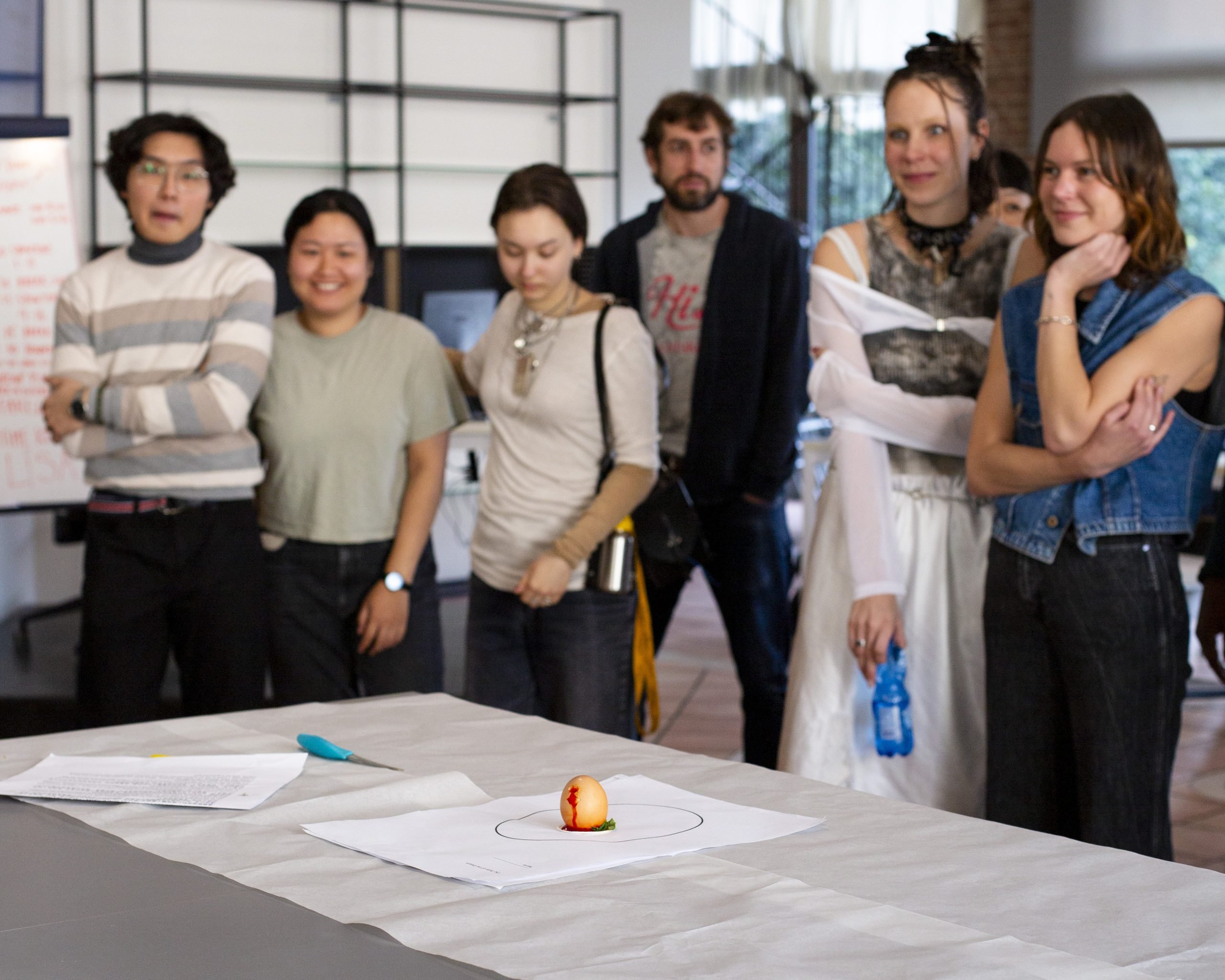
Taste and touch are two senses that are naturally intertwined in the eating experience.
Feeling texture, temperature, and consistency in the mouth adds layers to the complexity of smell, flavor, and overall sensoriality. However, designer and UNISG lecturer Giulia Soldati believes that the interrelation of taste and touch should go way beyond that. In fact, she believes we should take these matters into our own hands. Literally.
Giulia studied Social Design at the Design Academy Eindhoven in the Netherlands, where she initiated her career in food. As a student, her research focused on redefining and repurposing traditions, etiquette, and gestures to bring us closer to our food and to one another. This pursuit led her to create unique and immersive edible experiences, enhanced by the sense of touch, particularly through the use of our hands.
Her inspiration for this project stemmed from a time predating her design studies.
Being Italian, food has always been a quintessential part of her culture. Growing up in close proximity to it allowed her to recognize food's ability to foster conviviality, deepen connections with people, and ultimately, spark meaningful conversations.
Furthermore, as a kinesthetic individual herself, she believes that our hands are the most amazing tools we have, and that touching and manipulating materials facilitates learning. This is how in the context of a global need to reestablish connections with the environment, people, and food, Giulia set out to explore how these relationships transform when we remove the constraints of utensils and plates. Instead, she chose to design food for the purpose of enjoyment and experimentation, encouraging a more direct and tactile interaction through the use of our hands and fingers.
In this sense, Giulia's work is a pursuit of a return to a primal and instinctive approach to food. The overwhelming influence of progress, extensive technology, frenetic pace of modern life, and media saturation related to food have caused us to forget manual skills and the processes involved in cooking raw materials. While food traditionally serves as a unifying force, fostering discussions, exchanges, and connections, contemporary Western society has built numerous barriers between our sensory perception and the world around us. Consequently, we've distanced ourselves from food and lost awareness of what we consume. Merely by touching and interacting with our meals and ingredients, Giulia believes we can have a profoundly different experience that brings us closer to food, enhances our understanding, and leads to more informed choices.
Her ongoing series of taste and touch eating experiences, titled "Contatto", forms the foundation of this comprehensive research since 2017. Through it she has delved into the anatomy of the hand and explored the various positions it can assume to accommodate different types of food. A specific ingredient may inspire a particular hand position or vice versa. Consequently, every course in Contatto is previously studied, designed, and shaped.
As an eater, the hand, intricate and delicate, allows us to perceive numerous aspects even before tasting the food – its consistency, temperature, offering a pre-experience before it reaches our mouths. Moreover, the act of discarding cutlery and plates also discards the associated rules. For example, instead of twirling spaghetti around a fork, pasta is twirled around the fingers and mixed on the palm. Spilling and licking are not only permitted but encouraged.
In developing Contatto, Giulia drew inspiration from Indian culture, which has developed precise gestures and techniques for eating various grains with the fingers. Additionally, she found inspiration in Japanese culture, where food is sometimes prepared in front of diners with precision and care, which is something she does for her guests during her events.
Since 2017, the concept of touch has expanded for Giulia, encompassing a broader perspective that goes beyond the literal sense to explore how food can touch us figuratively. She is now interested in framing touch as a philosophical expression of care embedded in the processes of growing, choosing, transforming, and consuming ingredients. How many hands have touched, for example, a loaf of bread?
As a lecturer, Giulia has been a visiting professor of the UNISG New Food Thinking master since 2021.
In addition to imparting insights from her research and personal journey in food design, her lessons aim to elucidate the processes and steps involved in crafting a compelling eating experience.
Throughout the week she spends in Pollenzo each year, Giulia encourages students to explore their creativity in developing unique taste and touch eating exercises. She guides them in understanding how food can serve as a medium for personal storytelling, emphasizing the significance of physical interaction in sharing these narratives.
The students are prompted to consider novel approaches to preparing, transforming, and consuming ingredients with the body in unexpected ways, conceptualizing their own ideas.
The ultimate objective of this endeavor is to empower students with information and insights, enabling them to consciously test and create experiences that can have a meaningful impact on how people interact with food. Given the diverse backgrounds of UNISG students, the outcomes of these experiments are consistently fascinating.
In May 2023, during Giulia's class, our group crafted three eating exercises with the intention of delving into the act of feeding another person by hand as a rare and meaningful expression of care.
Giulia's research underscores that in the modern West, most cultures refrain from consuming food with their hands unless specifically designated.
That is why, during Giulia's events, participants find themselves challenged and initially uncomfortable when asked to consume a whole meal this way. However, even rarer in this context is the act of being fed or feeding another person with one's hands—a practice typically reserved for certain close and vulnerable relationships, such as a mother and her children, a couple, or an elderly person being cared for. In this scenario, being fed places one in a position of vulnerability, subject to the feeder's responsibility and powerful role of deciding the optimal way to execute it, considering elements like gesture, temperature, timing, and more. This situation can elicit a spectrum of emotions and reactions for both. With these insights in mind, we conceived a series of intimate and interconnected feeding/eating experiences tailored for both large and small groups.
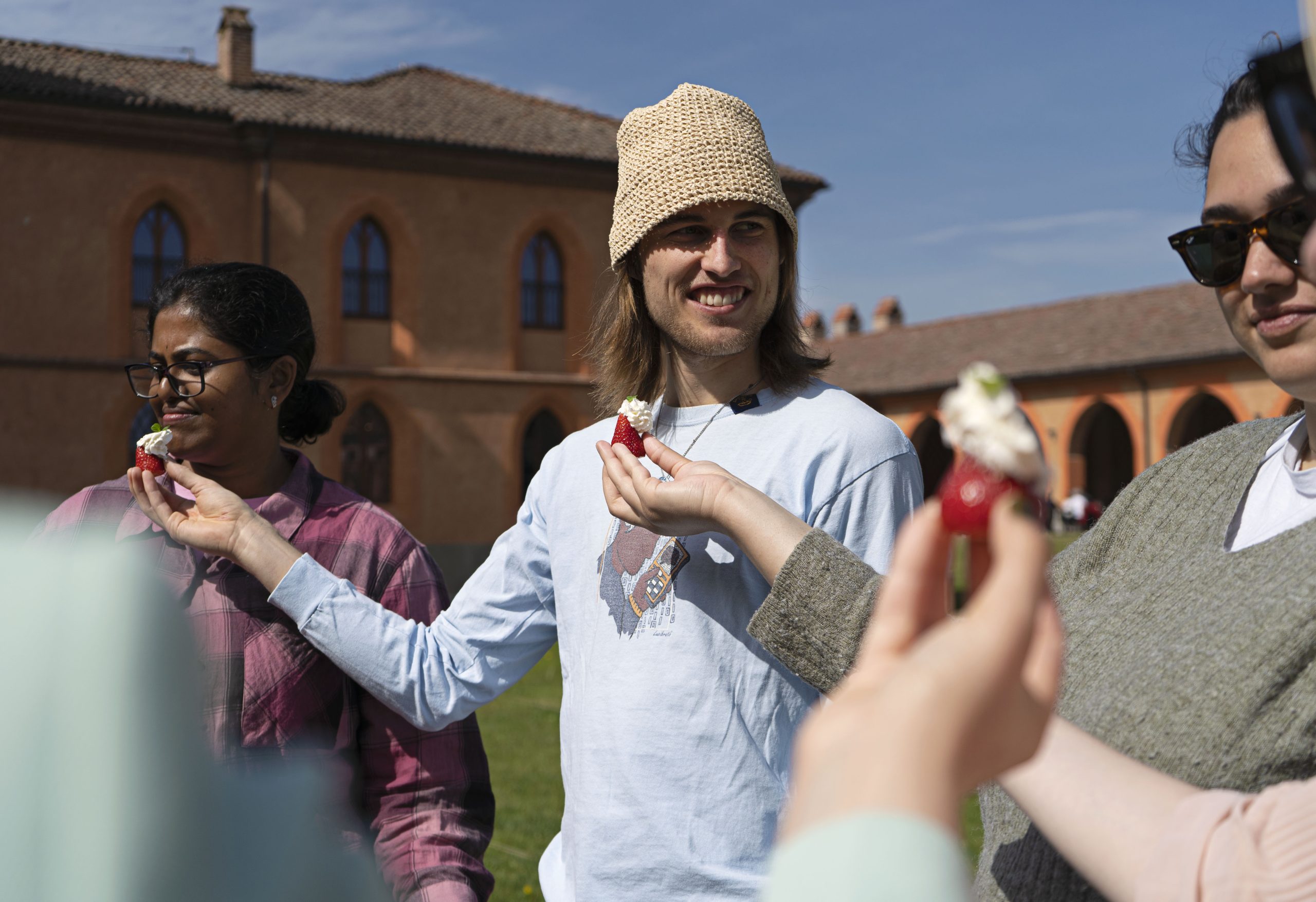
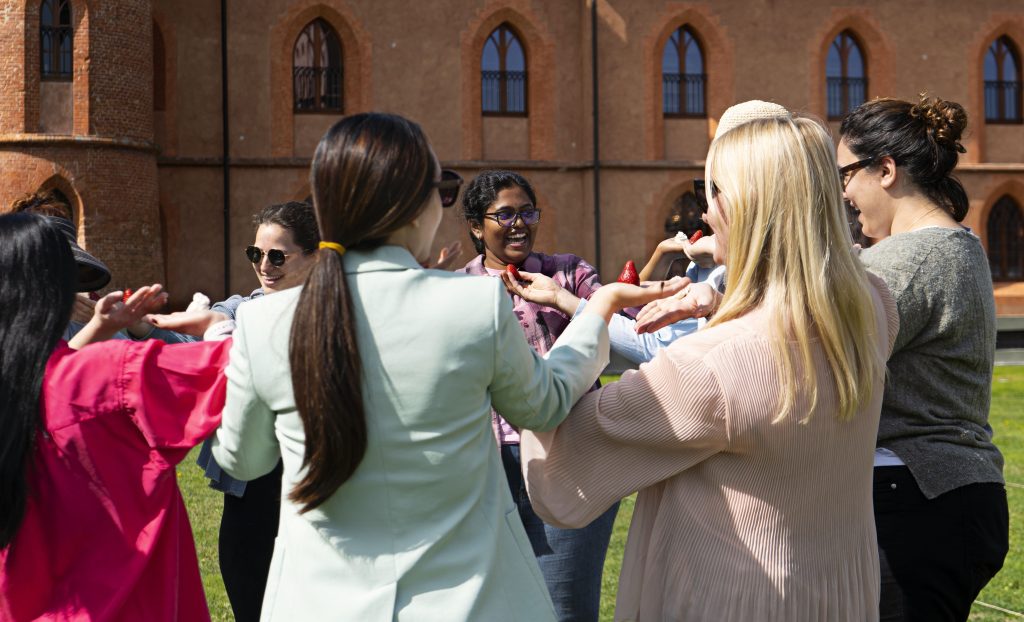
The initial exercise we devised involved a large group of people feeding one another strawberries and cream in a circle. Each participant extended their right arm, palm facing up, to receive a strawberry. Subsequently, they extended their left arm in the same manner, and whipped cream was piped onto their palm. The participants then offered the strawberry to the person on their right, bringing it to mouth level, and repeated the process with the cream on their left. Next, participants placed the cream on top of the strawberry on their left. Finally, each person directly consumed the strawberry in front of them and licked their hands clean.
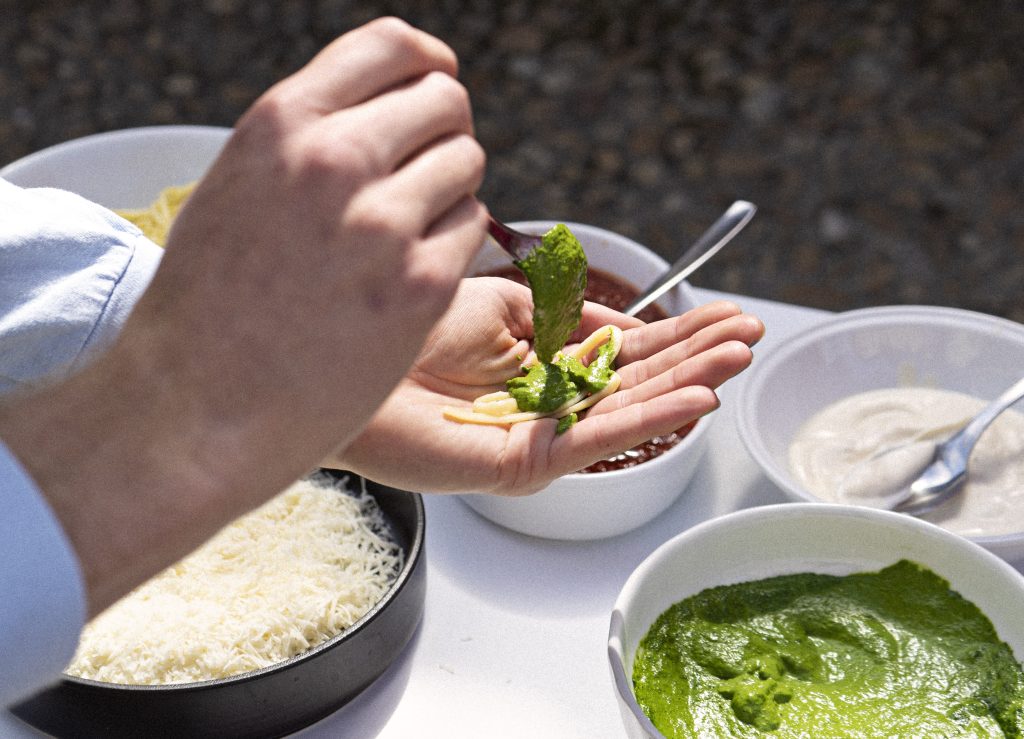
The second and third exercises were designed for two participants. In the second exercise, the person feeding (feeder) blindfolds the person eating (eater) and has them sit down. The feeder begins by asking the eater about their feelings that day and if they prefer the color green, red, or white. Next, the feeder prepares in silence a bite-sized portion of spaghetti (with pesto, pomodoro, or béchamel) in their hands. Afterward, the feeder asks if the eater accepts the food, if they do, the eater continues to discover the texture, shape and temperature of the spaghetti in the feeder's hands, figuring out the best way to eat it without visual cues.
For the third exercise, two people will pair up to prepare and enjoy an appetizer in a unique way. The first person stands very close to the second, who positions their back against the first’s front and stands facing a table or kitchen counter. The first person extends their arms forward, while the second extends their arms backward, creating a hugging-like stance. The first person's arms reach the surface of the table where all the ingredients are placed. The second person's arms remain wrapped around the back of the first. In this setup, the second person can't use their hands but can guide the first person in using theirs to prepare the appetizer. The first person follows these directions without seeing what they are doing, relying only on the sense of touch. Finally, the first person feeds the second the completed dish.
With these activities our goal was to dismantle social barriers in a playful and light-hearted manner, enabling the audience to explore the act of eating beyond the confines of Western norms. Simultaneously, we aimed to generate participants’ engagement with themes of vulnerability, cooperation, cleanliness, and disgust. Through Giulia’s class and these exercises we experienced how taste and touch, while being incredibly personal, can be used to push boundaries and generate a sense of collective intimacy. Ultimately, we discovered that people became more at ease with physicality, more open to communication, and found greater enjoyment in experiencing the qualities of food in a heightened and immersive manner.
Words and photos by Abril Sofia Macías Avila