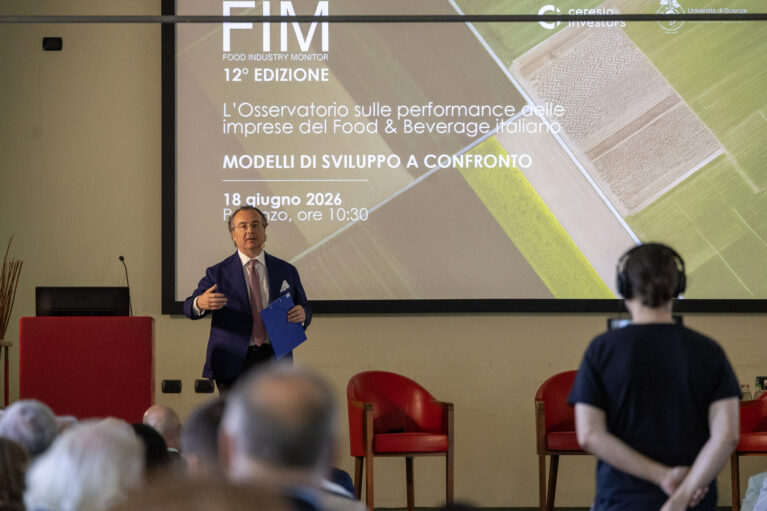
27 Giugno 2024
FOOD INDUSTRY MONITOR 2024 – X EDITION
“Ten years of the Italian food industry”
Pollenzo, June 27th 2024
The observatory on the performance and business models of Italian food companies conducted by the University of Gastronomic Sciences in Pollenzo and Ceresio Investors
- Over the past 10 years, Italian food has grown significantly from 53 billion in 2012 to around 90 billion in 2023.
- In 2023, the sector grew by 10% thanks to the decisive contribution of exports.
- The growth of the sector will continue in 2024-2025 at rates above GDP.
The Food Industry Monitor analyses the performance of a sample of about 840 companies, with an aggregate turnover of about 90 billion Euro, active in 15 food sectors. The Monitor analyses the historical performance of food companies from 2009 to 2023 focusing on the following dimensions: growth, exports, profitability, productivity and financial structure. Forecasts of turnover and export growth and profitability trends for the two-year period 2024-2025 have been drawn up for each sector.
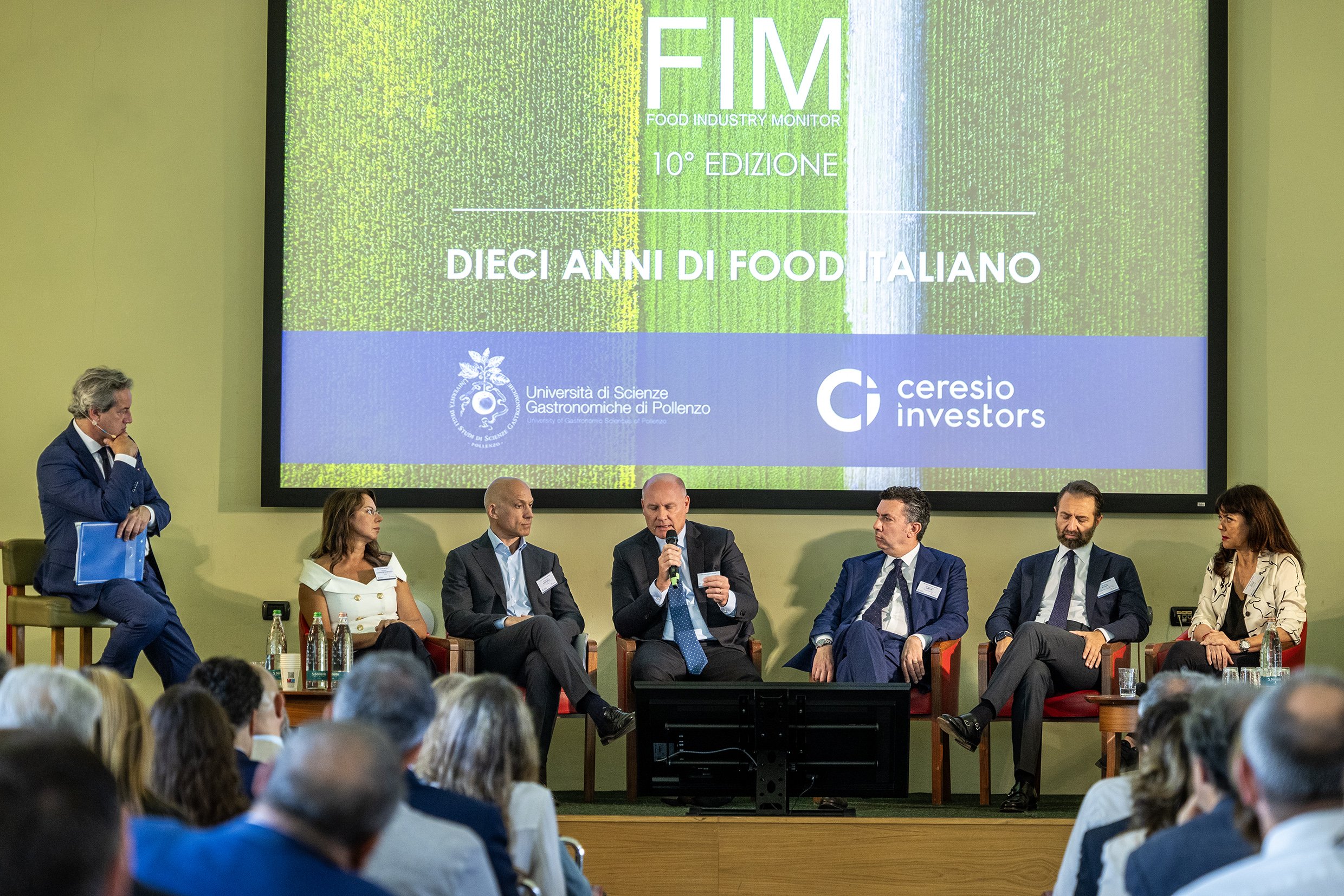
TEN YEARS OF THE ITALIAN FOOD INDUSTRY
Italian food has grown significantly over the last ten years, from a value of EUR 53 billion in 2012 to around EUR 90 billion in 2023. Exports have seen continuous growth, rising from EUR 23 billion to EUR 44 billion over the same period. Employment in the food processing industry alone increased from 449,000 to 488,000, a record growth of about 39,000, in a period that turned out not to be particularly good for the Italian economy.
Over the last ten years, Italian food companies have consistently outperformed Italian medium-sized companies (MBRES data) not only in terms of profitability (ROI), but also in terms of investment productivity and debt ratio.
Italian companies, known for their quality leadership position in many market segments, are still relatively small, with an average turnover of around EUR 97 million and 178 employees. From 2013 to 2022, the average turnover grew by 4.4% per year. Italian food remains characterised by the prevalence of family-controlled SMEs, which, while it has ensured a quality offer by balancing tradition and innovation, is an objective limitation in international comparison.
The companies in the Food Industry Monitor sample have made 72 acquisitions since 2009, of which as many as 26 towards international targets, for a total value of EUR 5.4 billion. Acquisitions are an effective tool for profitable growth; in fact, the companies that have made acquisitions have recorded an increase in turnover of just under 90% and an improvement in EBIT margin of 6% three years after the deal was concluded.
"We must emphasise the absolute excellence of the sector which, in 10 years, has been able to successfully overcome several economic crises, a pandemic, geopolitical tensions and deglobalisation processes, while continuing to grow above the national average, increasing exports and generating continuous interest in merger and acquisition transactions." Commented Gabriele Corte, Managing Director, Ceresio Investors.
PERFORMANCE 2023
2023 was an extremely positive year for the food sector with a growth of 10% thanks to both the good performance of the domestic market and the excellent performance of exports. In 2023, the sector's exports reached EUR 44 billion, registering growth of 6.3%, an excellent figure even if lower than the growth recorded in 2022, which was partly determined by price increases. Profitability figures show a largely positive scenario. Commercial profitability (ROS) reaches 5.1%, a figure in line with that recorded in 2022. The return on capital employed is close to 8% and is slightly higher than in 2022, thanks to the ability to optimise inventories.
"The sector continues to grow due to both good domestic consumption and strong dynamism on the international market. Quality exports are a decisive driving force of the Italian food sector." Explained Carmine Garzia, Scientific Director of the Observatory, Professor of Management at the University of Gastronomic Sciences in Pollenzo.
FORECAST 2024-2025
The sector's growth will continue in the years 2024-2025 at rates above GDP. Specifically, growth of +4.8% is expected for 2024, and 5.2% for 2025. Exports will also continue to grow; we estimate that in 2024 foreign sales will grow by 8.1% and in 2025 by 7.3%.
In 2024 typical Made in Italy sectors such as coffee, oil, spirits and wine will grow at rates above the market average, mainly due to good results on the international market. Other sectors such as pasta, milk and dairy products, and sweets will grow at slightly lower rates, suffering from the tensions generated by the distribution system and the contraction of consumption in some segments of the Italian market.
"The time has come for Italian food companies to consolidate the excellent results of the post-Covid period. Dimensional growth is a priority that must also be pursued through acquisitions and mergers that would not only benefit the individual company, but also the production chains." Highlighted Alessandro Santini, Head of Corporate & Investment Banking at Ceresio Investors.
ROUND TABLE – THE SPEAKERS
The conference was presented by Sebastiano Barisoni, deputy executive editor of Radio 24 Il Sole 24 Ore, who also moderated the panel discussion that included a representation of the major operators in the Italian food & beverage sector, in particular:
- Regina Corradini D'Arienzo, CEO of SIMEST
- Alessandro Santini, Head of Corporate & Investment Banking at Ceresio Investors
- Andrea Stolfa, CEO of Omnia Technologies
- Massimo Ambanelli, co-founder of HIFOOD, and COO of CSM Group Americas & Asia
- Federico Vecchioni, CEO of Bonifiche Ferraresi SpA
- Maura Latini, President of COOP Italia
The conclusions of the conference were traditionally entrusted to Carlo Petrini, founder of Slow Food and President of the University of Gastronomic Sciences.