01 Luglio 2025
The University of Gastronomic Sciences welcomed the American university's Summer School for a day of dialogue on taste as an aesthetic and social experience.
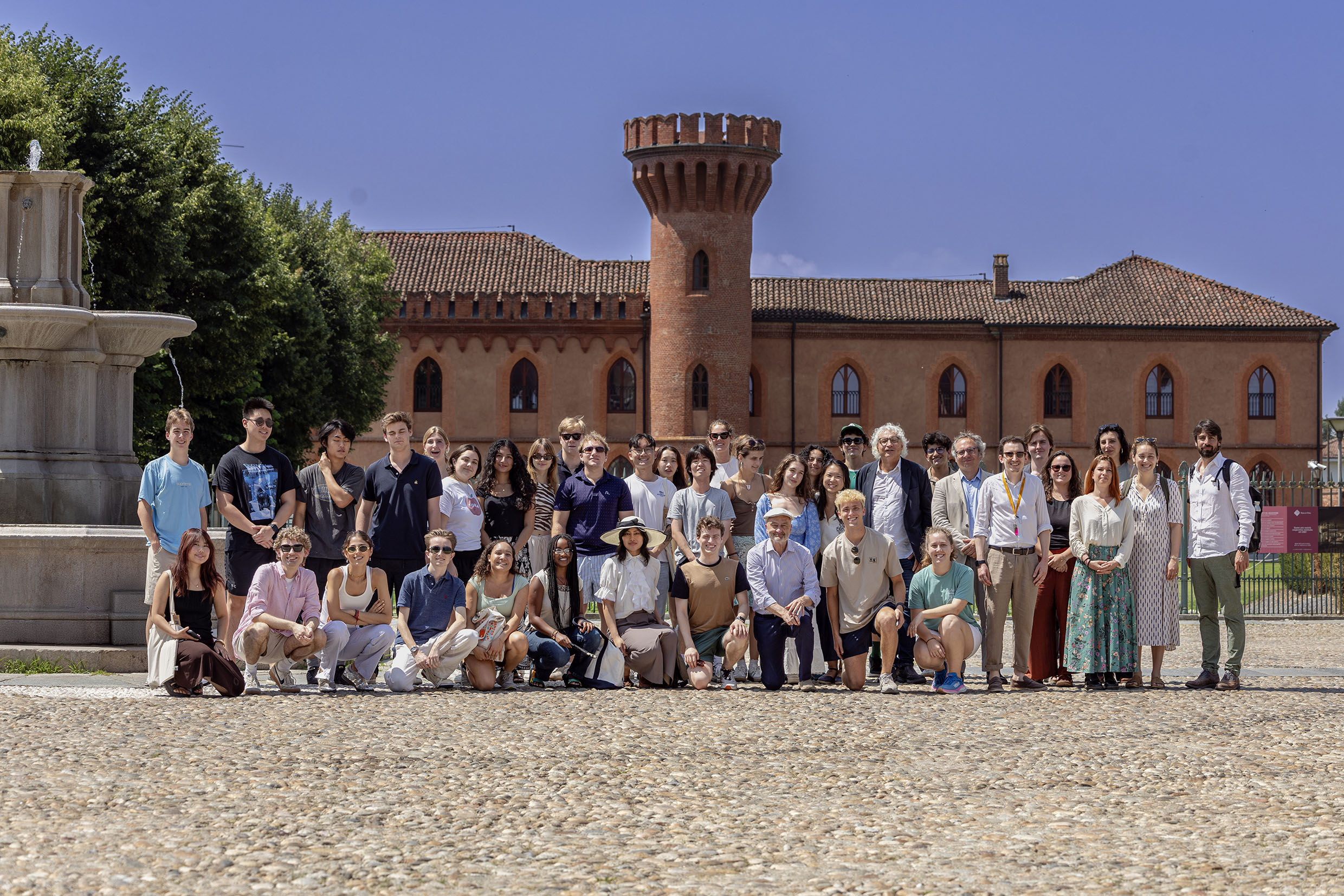
On Wednesday, June 25, the University of Gastronomic Sciences of Pollenzo hosted a group of students and professors from Harvard University as part of the Summer School "Beauty, Community and Innovation".
Thirty students, led by Prof. Francesco Erspamer, spent an intense day reflecting on the connections between beauty, culture, food, and collective responsibility.
Rector Nicola Perullo opened the session with a lecture on taste as a cognitive device: not simply a sensory perception, but a way through which the world reveals itself in its complexity and plurality. Beauty, he explained, is not a luxury but a form of attention, a wisdom that manifests itself in conscious choice, care, and conviviality.
Following this, Prof. Lorenzo Bairati presented a comparison between the European and American legal systems regarding food law, highlighting how different approaches reflect distinct visions of safety, quality, and responsibility in the food sector. His lecture sparked a critical reflection on globalization, protection of designations, and regulatory practices.
Dr. Elena Mancioppi explored the political and cultural dimension of smell. Through the concept of "osmophera," she illustrated how odors and aromas operate in social spaces, defining identities, boundaries, and relationships. In this perspective, food becomes a mediator of emotions, memories, and powers.
Dr. Riccardo Migliavada introduced the perspective of neuroscience and food psychology. His research investigates how we make food decisions—often unconsciously—shaped by evolutionary mechanisms, environmental contexts, and perceptual stimuli. Educating about taste, in this sense, means transforming environments and habits, not just providing information.
Dr. Elena Corcione then presented the connections between food production and human rights, with a particular focus on global supply chains. Labor exploitation, deforestation, and food access inequality are issues that require careful legal analysis and tools for shared responsibility among states, businesses, and civil society.
Prof. Simone Cinotto, a food historian and Delegate for Internationalization, concluded the meeting with a reflection on the meaning of the "Italian style" in gastronomic culture: a tradition that has managed to evolve between innovation and memory, local identity and global openness.
At the end of the morning lectures, the group was given a tour of the university, its facilities, and the ecological garden, and finally gathered for lunch at the Academic Tables, where UNISG President Carlo Petrini welcomed them.
The day represented not only an academic exchange between Harvard and Pollenzo but also an opportunity to reaffirm the centrality of food as a lens to understand the world, as a cultural practice, and as a space for building community.