26 Febbraio 2024
Inauguration ceremony of the 2023-24 academic year at the University of Gastronomic Sciences of Pollenzo
For the opening of the university's twentieth anniversary celebrations,
the Lectio Magistralis of the first Rector prof. Alberto Capatti “Bringing politics back into the realm of gastronomic science issues”
UNISG President Carlo Petrini “After recognition by the Italian academy, Pollenzo shall now make the leap towards internationality and look at the complexity of the world”
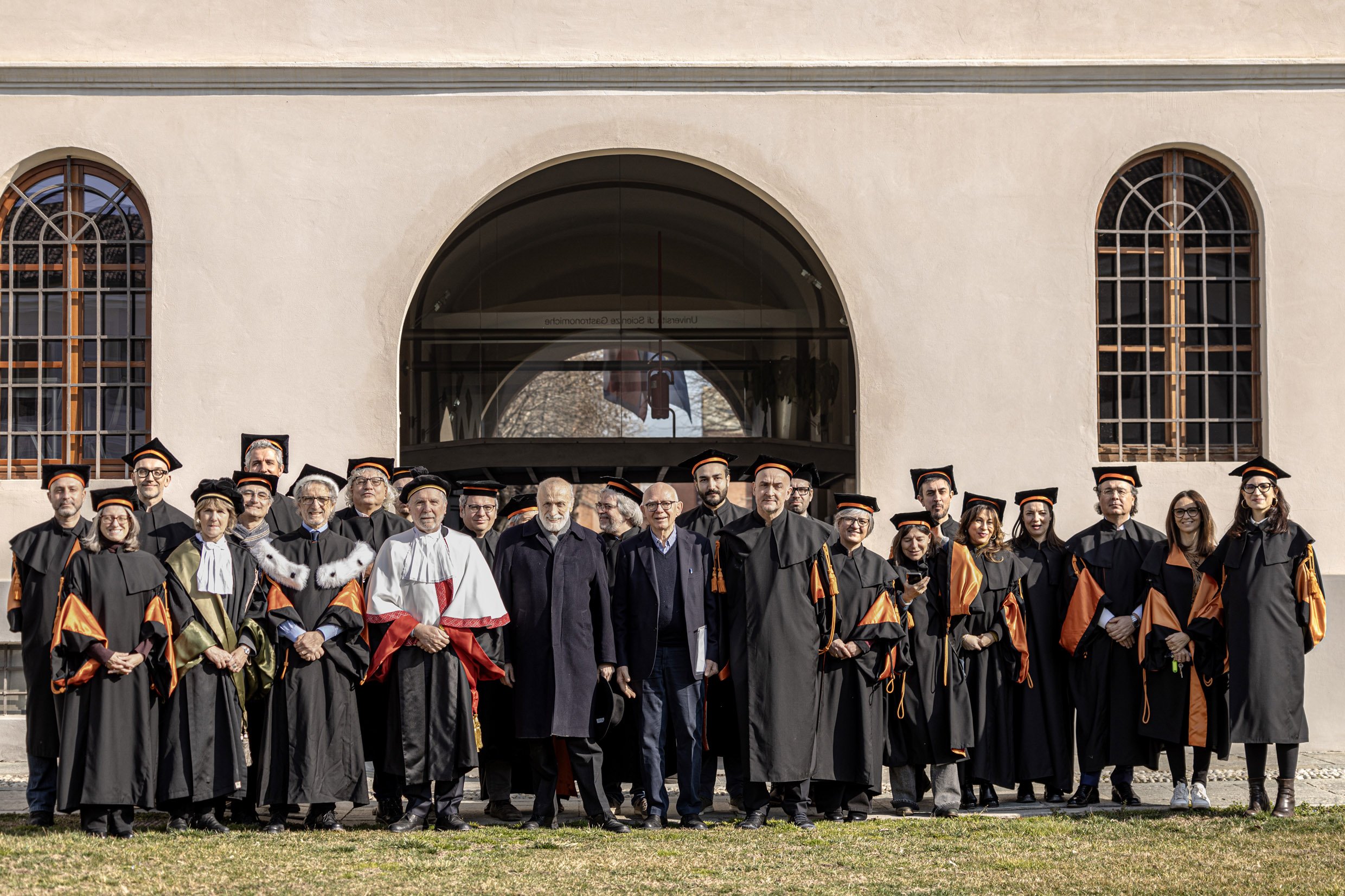
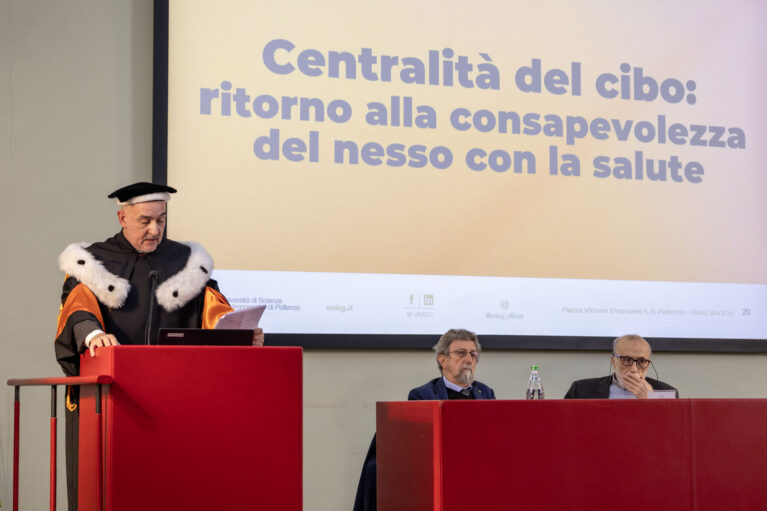
The inauguration ceremony of the 2023-24 academic year of the University of Gastronomic Sciences of Pollenzo took place on Tuesday 20 February. The morning was opened by the report of the rector Prof. Bartolomeo Biolatti, followed by greetings and speeches from the student representatives on the Academic Council Amanda Poles and Elisa Carone.
In his speech, rector Biolatti retraced the history of the UNISG project and indicated what the current vision of the university is:
“The holistic approach to gastronomic sciences gives ample space both to humanistic and social disciplines and to technical-scientific disciplines and life sciences, so that students develop their own thoughts, their own philosophy and their own ethics which will lead them to use them in the better scientific knowledge. The latter, deprived of ethics and morals, can have very serious and harmful consequences. Pollenzo trains a cultivated professional who knows how to interact responsibly with the environment and use his specialization to contribute to the management of a food system that safeguards natural resources and allows them to regenerate, taking care of the unique health of the environment, humans and animals.
My personal vision of UNISG is that of a university living lab, a dynamic environment in which the university collaborates with the surrounding community to face real challenges and experiment with innovative solutions. In the living laboratory concept, learning and research are integrated directly into the territory. In the case of Pollenzo it is no longer just a surrounding (local) territory, but a space that embraces the world. The characteristics of the university living lab and those of Pollenzo coincide and include the following points: Community involvement; Interdisciplinary Projects; Innovation and Experimentation; Experiential Learning; Sustainability and Social Responsibility; Technology transfer".
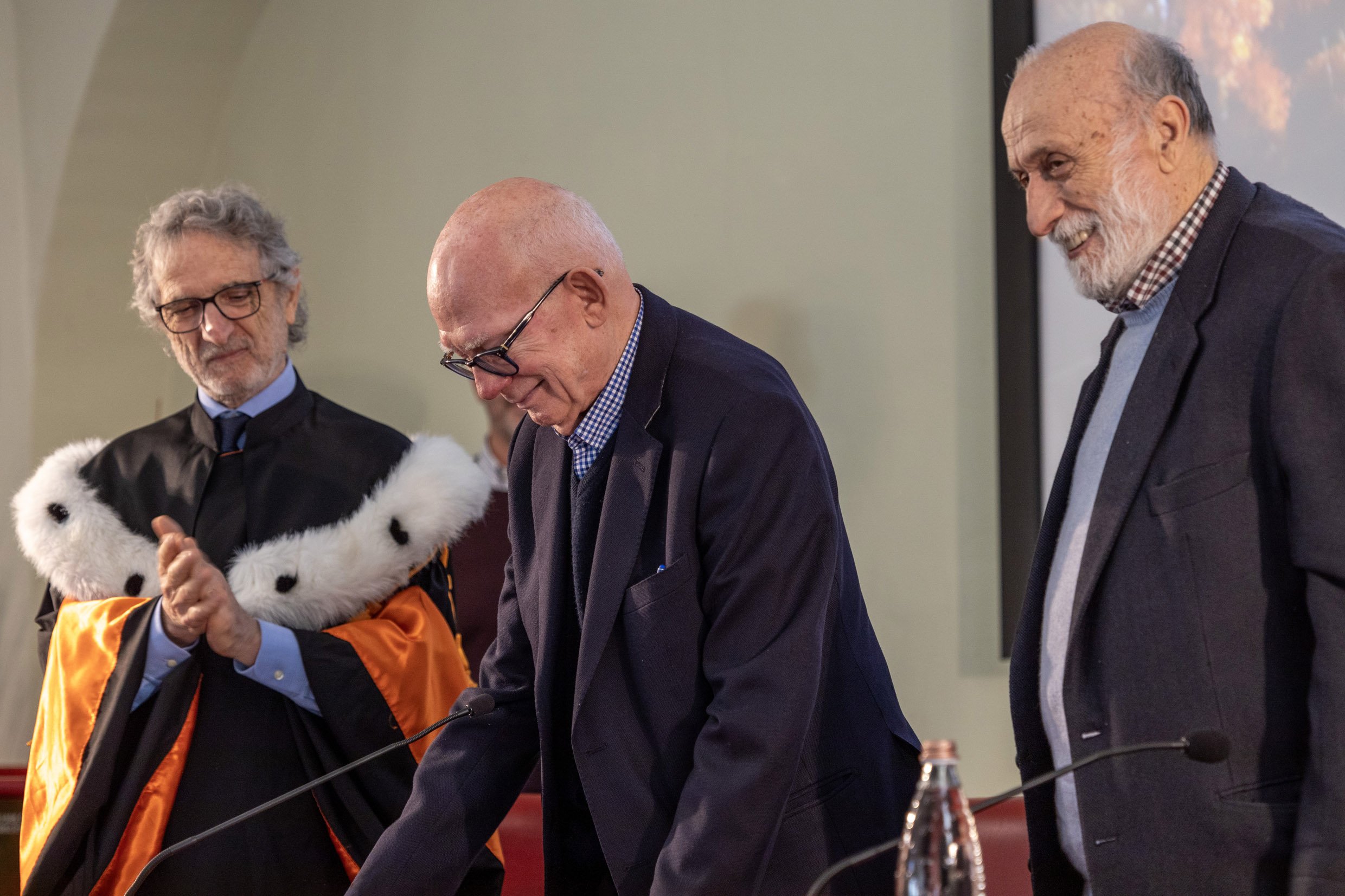
Guest of honor was Alberto Capatti, first Rector od the Pollenzo University, who held the Lectio Magistralis, in which he retraced the genesis of UNISG and launched new inspiring ideas for the future.
“This is a story that deserves to be told, as it values witness and planning. Its origin is unique, with Petrini at the center, surrounded by Montanari, a medieval food historian, Riva, a food technologist, and myself, an associate professor of French language and literature and a historian of contemporary food.
The history of this university, set to be written and published, involves a projective vision of a culture reborn in 2004. It's constantly evolving in an area profoundly transformed today by climate change and communication, by the conflict between vegan and carnivorous cultures, which were not in conflict back then.
The excellent novelty for students and teachers was trips where all the disciplinary heritage acquired became an object of thought and criticism, and they are an essential part of this story. Universities then ignored Gastronomy, and therefore, was a revolution from which new operators in the vast food field, kitchens, craftsmanship, and industry would have been born”.
“Pollenzo should be the center of the future and, therefore, a constantly active laboratory. To do this, a critical spirit that operates on the very notion of gastronomy is necessary. Let's return to Brillat-Savarin and the very purpose of gastronomy, "whose aim is to ensure the preservation of men through the best possible nourishment.
We must, therefore, assign to gastronomy a role that is not that of reasoned or reasonable knowledge but of critique of the food system, whatever it may be, starting from the present and returning to it. Critique today means self-critique, a word not found in Brillat-Savarin, and that will constitute our cognitive principle".
And on the topic of politics in gastronomic sciences he added:
“The second step will be to reclaim the politics inherent in the naming of the degree class, absent in Pollenzo, whose undergraduate degree is in Gastronomic Sciences and Cultures. Today, food policies are omnipresent, and gastronomy itself was created by an administrator and a politician, Brillat-Savarin, a prominent figure in the history of France from the revolution to the post-Napoleonic era.
Hence, politics is a historical approach to nutrition and should not be forgotten. It is the first step of a fundamental self-critical review, in the case of Pollenzo, where an analysis of other universities can be beneficial. Restructuring, writing, and teaching by making students the primary action nucleus, who will translate this policy into their future professions.
Politics is climate, sustainability, and economy; it regulates the life of the farmer and our own vision of nature and, as such, must be studied and promoted in times more challenging than ever to interpret.
A fundamental step will be the comparison between 17 different approaches to gastronomic sciences to make an overall assessment of their success, open the examination to other countries, and hypothesize new disciplinary structures and a new outcome of training. It is desirable not only for a meeting or a congress but for the creation of an Italian gastronomic teaching agency capable of creating a didactic heritage beyond university variations.
The opposition between those who study and those who eat insults gastronomic sciences by turning them into a philosophical theory solely valuable for thought. Eating is learning, and the teacher must participate instructively, savoring, chewing, commenting, and learning from the students themselves. It's easy to find theoretical insights about knowledge in texts and recipe books. However, suppose it's not materialized or experienced. In that case, you're lost in vocal bites that are assimilated by the ears and the brain only, with the result that no concrete comparison is realized, and you get lost in a ritual.”.
The president of UNISG Carlo Petrini closed the ceremony:
"Today we entrusted the opening of the twentieth academic year of UNISG to the first rector of our University. Twenty years ago Alberto Capatti contributed consistently to the name of "Gastronomic Sciences" and was among the very first to strongly believe in the interdisciplinary approach that characterizes always the University of Pollenzo. Today the name ‘Gastronomic Sciencesa’ has been taken on by 17 other Italian universities and this is the opportunity to take stock of the historical role that Pollenzo has had in recent years.
The considerations developed by Alberto Capatti are fundamental: in particular the importance of political education in our university, at a time when these issues become so crucial to the point that the demonstrations of these last few days, those with tractors, manage to undermine the structure of European food policy.
In fact, today we find ourselves with an environmental policy shaken by these protests.
This is the perfect storm because we have managed to put farmers against environmentalists, when instead there should be dialogue and mutual understanding. So today more than ever we must acknowledge that the founding ideas and demands of this university have found the right context".
And again, Petrini then recalled how Brillat Savarin in the third meditation of his Physiologie du goût prefigured the entry of gastronomy into the ranks of academic sciences.
“He probably wouldn't have imagined that he would have had to wait 180 years, just as he couldn't have believed that a university of gastronomic sciences would be born in Italy and not in his native France. In the same way, twenty years ago, when we had to find the title of this university, we chose gastronomic sciences: we also didn't think that 14 years later, in 2017, the Italian academy would recognize the graduating class.
Today we are called to achieve two objectives in our twentieth anniversary year. The first is a national objective, and was adopted by the Sustainable Food Study and Research Centre, which unites the 4 Piedmontese universities, recognizing Pollenzo as having a leading role. This is a campaign signed by a multitude of people to ask for food education to be included in schools of all levels.
The second objective concerns an international point of view, and here Capatti's thought acts as a great stimulus to decide what Pollenzo will do in the future. Now it's time to look at the world and overcome the thinking of Brillat Savarin, who still remains Eurocentric. We should cultivate Pollenzo's need to look at the complexity of the world, develop interconnected relationships on the world's food cultures. And here the value of the study trip becomes fundamental, which is one of the cornerstones of the UNISG didactic model. In Pollenzo, gastronomes should have a different idea of gastronomy, not centered on their own navel. This is why our university aims to become an international point of reference.
Gastronomic cultures are the result of crossbreeding: in crossbreeding there is the strength of welcoming and understanding others and this also changes the gastronomic language. This is the effervescence that is experienced in Pollenzo, which must become the home of all the food and wine biodiversity in the world."
Here you can read ALBERTO CAPATTI LECTIO MAGISTRALIS