13 Settembre 2016
Pinned to the corkboard over my desk are four plastic sheet-holders bearing e-tickets for Quito, Torino, Minneapolis and Portland, and Melbourne. Behind them is a scrap of paper that reads, in my own writing, “CHANGE FOOD BY BEING SPECIFIC (Jimmy Carter)”. On the floor by my feet is the much-lauded cookery tome, Anita Stewart’s Canada, and next to it, a couple of jars of maple sugar granules and several bags of indigenous herbs and teas.
These are just a few of the artifacts that make up the Eco-Gastronomy Project—items of planning and research and gift-giving. Of course, the project also involves workshop outlines and press releases, photos and videos and poster graphics, and endless emails among the hundreds of people who together comprise this remarkable “network of knowledge exchange.”
It is those individuals, and the moments in which we all come together, that form the core and the future of this experiment in sharing ideas and practices about food. They are the ones in whose bodies and minds and guts the knowledge about eco-gastronomy actually resides, and they are the ones who will determine—through their ongoing actions and words—whether this project will have been a success.
Eco-gastronomy, like all things we do with food, is an enactment. Its reality doesn’t exist in documents like my planning schedules or in the manifesto that our website expresses. Eco-gastronomy is a way of being in the world, and a way of feeling and doing with food that recognizes that humans are continuous with food—one holistic system in which we are as much things that eat as we are things that get munched upon. It is a way of attending to both the material world and the discursive one, and recognizing that the processes and practices in which we participate entangle words and substances, while also producing complex effects within them. Eco-gastronomy is about paying more attention to our actions with food, and being more willing to recognize that humans are really not the most important things on the planet.
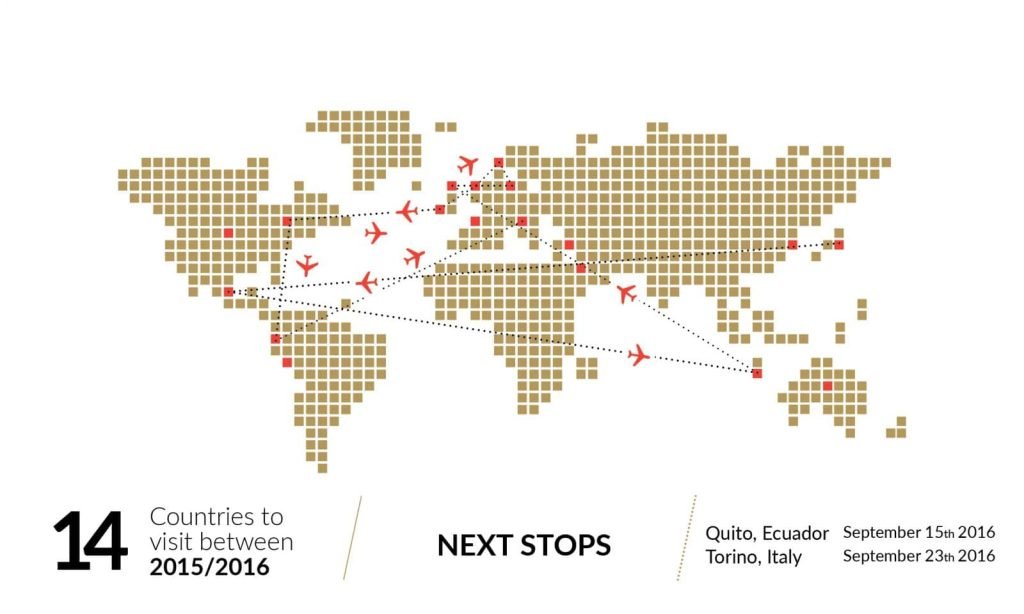
Between the last months of 2015 and now, I have been to a lot of different places—in Asia, Europe, North America. Over the summer, I took a needed pause from the travel, because it was necessary to reflect, to synthesize, and to plan the next chunk of work. I spent that time in my home city of Montréal, and took the opportunity to make some bread and kimchi, some pickles and jams. I also ate and drank with friends, and spent time breathing in the humid summer air. I felt this place, and sensed the ways in which it contributes to making me who I am, just as I do to it. And despite my excitement for what is to come, I have to say that I am a little sad to start getting on planes again and moving through other foodscapes. (I am also well aware of my heavy carbon footprint and the other energies being expended by my movements.) But there is still much to learn, do, feel, and share.
The Eco-Gastronomy Project is without doubt one of the most compelling experiences I have experienced to date, and I do believe that it (as our briefing document proclaims!) is producing great value in the world. But as I look at the plane tickets and heritage recipes and food items and notes to myself that litter my home office, the tension between going out into the world and remaining and receiving is very present. This is a tension that many gastronomes sense, I believe, because the food is both global and local at once, filled with opportunities and challenges at all scales. We want to change things by being universal; we want to change things by being specific.
Perhaps, by the end of this year, and once those e-tickets have all be used and filed away, one of the knowledges that will have been produced for me is how eco-gastronomy and I—and all the others who continue to enact it—belong to each other in the long term. Then I might know how I can be most useful in the world, and where that value is best produced.
(Thanks to the ever-wise thinker and wordsmith, Lisa Heldke, for letting me borrow the “munching” reference. Although, of course, she didn’t actually let me borrow it, I just used it.)