03 September 2026
Thursday 17 and Friday 18 September in Pollenzo: an international conference on food, memory, the transmission of knowledge, and identity across generations
The conference brings together scholars and researchers from leading international universities, including Yale, the Sorbonne, Durham, Duke, Coimbra, and California.
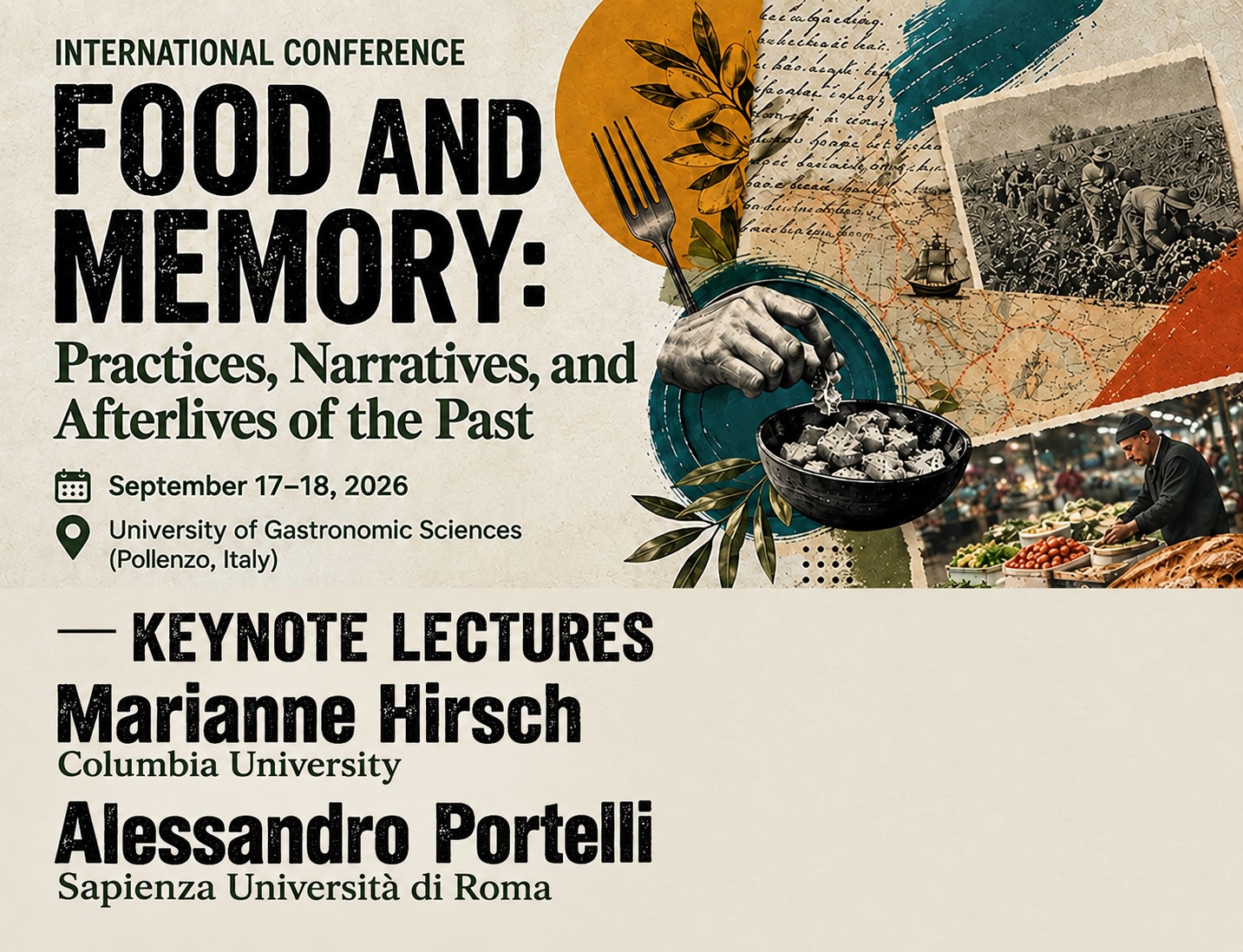
University of Gastronomic Sciences, Pollenzo | 17–18 September 2026
How do we remember through food? And what can cooking, eating, flavours, hunger, and conviviality tell us about the ways in which the past continues to inhabit the present?
On 17 and 18 September 2026, the University of Gastronomic Sciences will host the international conference Food and Memory: Practices, Narratives, and Afterlives of the Past, bringing together scholars from different disciplines and leading universities (Yale, Sorbonne, Durham, Duke, Coimbra, and California) to explore food as a privileged site of memory.
The conference starts from the premise that food is much more than nourishment or cultural tradition.
Everyday practices of preparing and sharing food can function as embodied archives, transmitting experiences, identities, relationships, and stories from one generation to the next.
At the same time, food can make visible experiences that are difficult to narrate: hunger and deprivation, displacement and exile, colonialism and war, as well as silence, loss, and historical trauma.
Food also reveals the horizons of human geography and the contours of a collective imaginary, as well as forms of mobility and strategies for overcoming obstacles, barriers, borders, and wars.
While food studies have long explored issues related to identity, migration, and heritage, and memory studies have examined the transmission and legacies of the past, systematic dialogue between these two fields remains relatively limited.
The conference seeks to bring these perspectives into conversation, asking not only how food preserves memories, but also pursuing a new interpretive trajectory: investigating how memories are transformed, contested, forgotten, reinterpreted, and inherited through food.
Across seven panels, participants will explore the relationship between food and the memory of the Holocaust; the legacies of empires and food in institutions; embodied practices and rituals; transnational memories of Italian food; food and the legacies of war; diasporic cuisines, gender, and heritage; and food, exile, migration, and belonging.
Spanning different historical periods and geographical contexts—from Europe and the Mediterranean to Asia, Africa, and diasporic communities—the presentations will examine food through oral sources, family narratives, domestic practices, literature and media, material culture, and the everyday gestures of cooking and eating.
The conference will feature two keynote lectures by Alessandro Portelli, whose research has profoundly shaped the field of oral history, and Marianne Hirsch, whose influential work on postmemory has transformed the study of intergenerational memory.
Taken together, the two days invite us to consider food not simply as something through which the past is preserved, but as a space in which the past is continually remembered, embodied, negotiated, and reworked.