
MSc in Food
& Planetary Health
A transdisciplinary course that looks at food and health through a planetary perspective.
FORMAT
Mandatory attendance (except for part-time students)
LANGUAGE
English
DURATION
2 years
CREDITS
120 ECTS
START
September 21, 2026
SCHOLARSHIPS
Available
MAXIMUM NUMBER OF ADMITTED PARTICIPANTS
40
The Master's Degree in Food and Planetary Health is the only program jointly offered by UNISG, the University of Turin and the Venlo College of Maastricht University, combining the One Health approach with that of Planetary Health.
The program is designed to explore how food systems and food policies can be reimagined to promote health, sustainability and equity, both at a local and global scale. Through campus mobility, hands-on projects and immersive learning, students develop the knowledge and skills needed to lead the food transition at the intersection of environment, nutrition and social justice. Combining the international dimension of Maastricht University with the ecological mission of UNISG, this MSc offers unparalleled depth in food systems transformation. Entirely delivered in English, it integrates nutritional sciences, humanities and social sciences with dedicated modules in health, law, agroecology and sustainability.
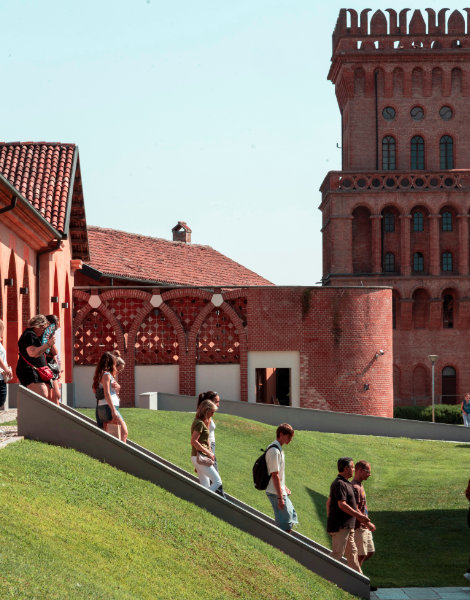
Lessons in Pollenzo in the first year
Lessons in Maastricht in the first semester of the second year
Internship in the second semester of the second year
Interdisciplinary Focus
WHY UNISG?
- The only master's program in Europe that integrates One Health, food policies and Planetary Health in an applied academic context
- Hybrid skills combining human nutrition, agroecology, food governance and environmental sciences
- Collaborative field research activities and projects connecting academic theory and applied innovation
- A program entirely in English with a European and global perspective on food systems
- An international community from over 100 countries
In collaboration with

Skills and Objectives
Unique in its structure and vision, this program integrates health, sustainability and food systems through a carefully designed sequence of modules. Students explore the interconnections between human, non-human and planetary wellbeing starting from the One Health theoretical framework. They deepen their knowledge of nutrition, microbiota, animal welfare and taste sciences, while also engaging with agroecology, planetary health, philosophy and food governance.
The curriculum is structured over two years. The first is focused on foundational knowledge in health and ecological regeneration, enriched by a cultural immersion in the Italian context. The second year opens up to global systemic thinking, offering tools for policy analysis, environmental assessment and applied research.
Study Plan
The study plan of the Master's Degree in Food and Planetary Health progressively builds a profile capable of reading the food system through the lens of human, non-human, and environmental health.
The program progresses from nutritional and microbiological foundations to the ecological dimension of food production, through to the analysis of global governance and the planetary impact of food. Students complete their training with an elective course of their choice, an internship, and a final thesis.
Courses may be subject to change.
Lessons in Pollenzo:
- One Health and the Human Condition
- Taste and Health
- Blue and Green Regeneration
- Human Nutrition
- Microbiota and Human Health
- Livestock Systems and the One Health–One Welfare Approach
- Agroecology and Sustainable Food Production
- Italian Culture and Language
Lessons in Maastricht:
- The Ecological Foot(d) print
- Planetary Health
- Global Health Nutrition
- Food Governance and Law
Elective*
Internship
Final thesis
Career Opportunities
Graduates become Food & Planetary Health Strategists, professional figures who embody the program's approach: systemic thinkers, prepared to connect food to human, non-human and planetary wellbeing through the One Health theoretical framework. They collaborate with agri-food companies, the restaurant and hospitality sector (HoReCa) and public institutions to promote healthy and sustainable nutrition as a public health tool. They design and promote sustainable, seasonal, low-impact and nutritionally valuable menus. Thanks to a solid education in human nutrition, they are able to assess the quality and impact of food choices, complementing the work of healthcare professionals. They operate as One Health experts in food, integrating sustainability, health and social responsibility into organizational strategies. Their systemic vision supports resilient and responsible food chains in educational, community and corporate contexts.
Action Learning
Action learning activities are an integral part of the programme, offering direct contact with the reality of the agri-food sector. By going beyond the classroom, students meet professionals, observe food systems in real contexts and apply the knowledge they have acquired. These experiences strengthen critical thinking, collaborative skills and the preparation needed to competently address the challenges of the global food system.
Faculty
The MSc in Food and Planetary Health faculty brings together academics and professionals with expertise ranging from human nutrition to ecology, from planetary health to global food governance and microbiota sciences.
Coordinator: Prof. Flavio D'Abramo
Meet some of the professors teaching on this programme:







Admission Requirements and Procedures
For all information about admission requirements, language requirements, how to register for the competition, the competition tests, important dates, admission criteria, and registration procedures, download the document Admission Requirements and Procedures.
Follow the steps below to submit your application through UNISG's ESSE3 portal, the student records system used by Italian universities.
- Click the Apply Now button at the top right of this page.
- Click Web Registration and follow the on-screen instructions to create your account.
- Open ESSE3 di UNISG portal in your browser.
- Select Login from the top right menu.
- Enter your username and password to access your account.
- From the top right menu, click Registrar's Office.
- Click Admission Process.
- Select your desired program from the list.
- Follow the on-screen instructions to complete your application.
CALENDAR
Opening of applications
December 1, 2025
First session deadline
March 10, 2026
Second session deadline
May 19, 2026
Third session deadline
July 14, 2026
Start date
September 21, 2026
Late applications may be considered. Please contact the Register’s Office (segreteria@unisg.it) for further information
Visit UNISG
We offer a range of in-person and online events designed for prospective students who are considering joining the UNISG community. Whether you prefer to visit our campus or connect with us virtually, these are the perfect opportunities to explore our academic programs, meet our faculty and staff, and get a real feel for life at UNISG.
Find out more about our Orientation Days, Open Days and individual campus visits.
Tuition Fees and Scholarships
The annual fees for the Academic year 2026/27 is € 14.000 and it includes:
- all academic activities, including conferences, tastings and seminars;
- expenses related to company visits, such as transportation and meals.
- participation in many UNISG and Slow Food events as included in the undergraduate program;
- access to Career Center services (food sector job placement)
- enrollment certificates, official transcripts, receipts of payment.
UNISG scholarships are available to applicants of all nationalities, enrolled in the first-year of the Graduate Degree in Food and Planetary Health.
The scholarships are valid for the first year of the course and may be renewed for the second year, provided that the student maintains the academic requirements specified in the scholarship public announcement.
MERIT-BASED AND NEED-BASED SCHOLARSHIP
New - Scholarship Announcement for 2 total fee exemptions (€14,000) and 5 partial fee exemptions (€7,000) based on Merit and Financial Need
Italian Candidates
- Documents requested
- Merit requirements to confirm the scholarship
- Scholarship Application form for Italian Candidates
Non-Italian Candidates
All UNISG students who are currently completing or have already obtained a Bachelor’s degree, a Master’s degree, or a First-level Master’s degree at our University are eligible for a €4,000 tuition fee reduction for both the first and second year of the program.
The reduction will be applied upon payment of the second installment each year.
To maintain the benefit in the second year of the program, students must meet the following requirements after the September exam session:
Credits: at least 40 CFUs
Weighted GPA: 27/30 or higher
All students who attended UNISG Summer Schools are eligible for a reduction of 500 euro from the university fee applied to the second installment of the 1st Year.
For the academic year 2026/2027, UNISG has allocated a total of €103,000 across all degree programmes to cover fee waivers for EDISU scholarship recipients, until funds are exhausted. Waivers are therefore awarded following the EDISU eligible candidates ranking, starting from the highest positions, until the allocated resources run out. Once these funds are depleted, the remaining students on the ranking list will not be eligible for a full fee waiver for the relevant academic year.
- Recipients: Italian Students residing in Italy (fee-exemptions assignees or not).
- Partner Bank: Intesa Sanpaolo (official website).
- Guide to “Merit Loan- Prestito per Merito” (downloadable here)
Students with United States citizenship are eligible to apply for American financial aid through the William D. Ford Federal Direct Loan Program. Note that for all UNISG programs, loan applications must be initiated by the student and received at UNISG electronically.
Maximum Loan Amounts
Direct Stafford Loans are need based (subsidized) and non-need based (unsubsidized) and are subject to annual limits. The loan calculation is based on information from your FAFSA, information about other financial aid you are receiving and the cost of attendance (tuition and living expenses) which is set by the university.
Several steps are involved in applying for financial aid. Ensure that you start the process early in order to complete all steps in accordance with both the US Department of Education and UNISG deadlines.
As loans of all kinds involve serious financial commitments, UNISG requires that students be fully responsible in ensuring accurate and timely submission of their FAFSA. Although in some cases a student’s parents may help with completing the form, the student is considered ultimately responsible for his or her application process.
Applying
To apply for a Direct Loan, you must:
1. Complete a FAFSA (Free Application for Federal Student Aid). In completing the FAFSA, you must indicate the UNISG Federal School Code (also called the Title IV Code): G41391.
2. E-Sign an MPN (Master Promissory Note).
3. Email the UNISG Financial Aid Office , indicating the total amount of the subsidized loan or the unsubsidized loan you are applying for. Also indicate any other financial aid or scholarships you are receiving, as well as any other documentation or information you wish to transmit that was not included in your FAFSA. All amounts should be shown in US dollars and you should indicate the UNISG program you are applying for.
4. Complete entrance counseling, if you are a first-time Stafford Loan applicant.
Deadlines
– FAFSA submission: within five days of the UNISG Registrar’s announcement of accepted candidates.
– Acceptance of UNISG admission offer and payment of initial deposit: within five days of receipt of loan confirmation from UNISG Financial Aid.
Disbursement of Funds
FSA funds are not disbursed directly to the student. Disbursements are made to UNISG and applied to the student’s university account. Funds in excess of the student’s university fees will be disbursed to the student’s personal bank account once the student arrives at UNISG. All currency exchange rates are based on the rate in effect on the day of deposit of funds.
All students receiving US federal financial aid must demonstrate satisfactory academic progress (SAP) during their UNISG program, according to the university’s SAP policy. Additional details regarding SAP will be provided to students upon enrollment.
For more information, contact: UNISG Financial Aid Office
UNISG Federal School (Title IV) Code: G41391
CALENDAR
| Payment | Amount | Deadline |
|---|---|---|
| Deposit | €2,000 | Within 8 days of admission notification |
| 1st installment | €7,000 | September 01, 2025 |
| 2nd installment | €5,000 | February 25, 2026 |
Scholarship Application Deadline:
14 July 2026
Notification of Scholarship Awardees: 20 July 2026
Where does a UNISG graduate work?
UNISG graduates build careers across diverse sectors of the food industry. The interdisciplinary training, which integrates technical, cultural and methodological expertise, prepares students for roles in business, innovation, public institutions and entrepreneurship. Our alumni apply the skills acquired during their studies to address complex challenges in the food system and society.
Graduates work in product development and brand strategy for food companies, beverage brands and retail organizations. Their understanding of food systems, consumer behavior and market dynamics enables effective product positioning and brand value creation in competitive markets.
Our alumni work as:
- Global Brand Manager
- Export sales manager
- Global Communication Manager
UNISG graduates work as specialized journalists, content creators and communication managers for media outlets, companies and organizations. They communicate complex topics to diverse audiences, addressing sustainability, culture and science through editorial content, visual media and digital platforms.
Our alumni work as:
- Food & Sustainability Journalist
- Content Strategist – Media and Corporate Communication
- Communication Manager – Food and Environmental Organizations
Some graduates launch businesses in the food sector: restaurants, food production, agritech ventures and specialized startups. Their interdisciplinary training in business, innovation and food systems provides the tools to develop innovative concepts and scale enterprises.
Our alumni work as:
- Founder & CEO – Food Startup
- Owner – Innovative Food & Beverage Project
- Agritech Entrepreneur
UNISG graduates contribute to policy development and program implementation in government agencies, NGOs and international organizations. They work on food policy, agricultural development, nutrition and sustainability, addressing food security and systemic change at both local and global levels.
Our alumni work as:
- Food Policy Officer – NGO or International Organization
- Programme Coordinator – FAO / UN Agencies
- Agricultural Development Consultant – Government Bodies
Consulting firms employ UNISG graduates to support food companies, retailers and organizations on strategy, sustainability, supply chain management and innovation. Their multidisciplinary perspective enables them to assist clients in navigating complex operational and strategic challenges.
Our alumni work as:
- Sustainability Consultant – Agrifood Sector
- Gastronomic Heritage Advisor – Cultural and Territorial Institutions
- Sustainability & Supply Chain Advisor – Food & Beverage Industry
Universities, culinary schools and professional training organizations employ UNISG graduates as lecturers and trainers. They teach food systems, sustainability, culture and innovation through academic and specialized programs.
Our alumni work as:
- Lecturer in Food Systems & Sustainability
- Curriculum Developer – Culinary Schools and Professional Programs
- Trainer – Food Education Programs
The hospitality and food service sector employs graduates in management roles: restaurant management, menu development, culinary operations supervision and team coordination. They apply their gastronomic, cultural and managerial expertise to create distinctive dining experiences.
Our alumni work as:
- Restaurant General Manager
- Food & Beverage Director – Hospitality Venues
- Culinary Operations Coordinator
Work on Real Projects
With Industry Leaders
The Strategic Partners Club is an international network of organizations, businesses, and professionals operating in over 50 industry sectors: from production to distribution, from catering to food packaging. The partners recognize Pollenzo as a center of excellence in transdisciplinary research and innovation in the world of food, and collaborate with the University on concrete projects: corporate training, innovation initiatives, and shared research pathways. It is a network that students begin engaging with as early as their first year of study.