22 October 2026
A project born from the dialogue between Politecnico di Torino and the University of Gastronomic Sciences of Pollenzo, with the Archivio Storico della Città di Torino and Urban Lab. Opened during Terra Madre, the exhibition can be visited until 31 October in Piazza Palazzo di Città.
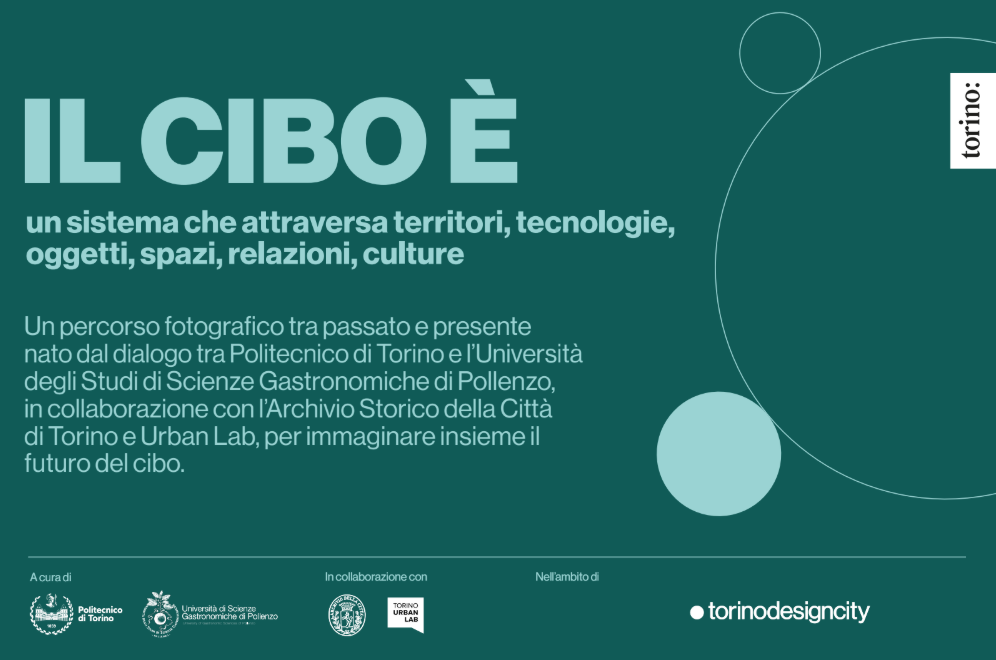
Inaugurated during Terra Madre, the exhibition “IL CIBO È” will remain on display until 31 October in Piazza Palazzo di Città, home of the City of Turin’s municipal offices.
It is a photographic journey through past and present that portrays food as a complex system, one that crosses territories, technologies, objects, spaces, relationships and cultures.
The exhibition grew out of a collaboration between the University of Gastronomic Sciences of Pollenzo (UNISG) and Politecnico di Torino, two universities that chose to join their expertise to communicate a shared vision of food and to present the new degree programme in Food Tech for Ecological Transition.
The exhibition was curated by Prof. Franco Fassio (UNISG) and Prof. Silvia Barbero (Politecnico di Torino), with Sara De Menech, Maria Piochi, Gisella Gervasio, Manuela Rondoni and Paola Traversi.
A fundamental contribution came from the Archivio Storico della Città di Torino, which provided photographs, drawings and historical documents for the section devoted to the past.
“We wanted to portray food as a system that nourishes us, connects us, represents us and projects us into the future. Bringing historical and contemporary images into dialogue helps us understand how today’s challenges stem from a long history of relationships between people, territories and technologies. The collaboration between our two universities, together with the Archivio Storico della Città di Torino and Urban Lab, shows that tackling the complexity of food systems requires different perspectives and skills working together”.
Franco Fassio (UNISG) and Silvia Barbero (Politecnico di Torino), scientific curators of the exhibition.
Thirteen words, thirteen perspectives
The exhibition is organised around thirteen keywords, each offering a different way of reading food: City, Right, Technology, Time, Infrastructure, Relationship, Home, Experience, Identity, Coevolution, Biodiversity, System, Future.
Each theme is told through two images with captions, one from the past and one from the present, in a dialogue that spans the centuries.
The journey thus ranges from the haystacks in the streets of seventeenth-century Turin to the Politecnico’s experimental fields (Food is City), from the nineteenth-century plan for a municipal public bakery to the production lines of the food industry (Food is Right), and from the Perc-O-Toaster of the 1920s to wafers without wrappers (Food is Technology).
It continues with the vermouth cellars and contemporary solutions for measuring food freshness (Time); the railway entering the factories and the digital platforms delivering from markets (Infrastructure); Porta Palazzo as a hub of exchange between countryside and city and as a meeting place for different cultures (Relationship); the historic cafés and the places of collective memory (Home); the tables of Francesco Chapusot and new forms of conviviality (Experience); the Aperitivo Savoia advertisement and packaging that reinvents itself (Identity); the urban vegetable gardens of 1942 and Terra Madre Salone del Gusto (Coevolution); Garnier Valletti’s pomological collection and the threshing of rye in the Valle Gesso (Biodiversity); and the Venchi factory and the Politecnico’s Systemic Design (System).
The exhibition closes, or opens, depending on where visitors begin the journey, with “Food is Future”: from the ice market of 1950, destined to be superseded by domestic refrigeration, to the need to train new professionals capable of understanding and designing the complexity of food systems, just as the new degree programme in Food Tech for Ecological Transition, offered by UNISG and Politecnico, proposes to do.
Information
Exhibition “IL CIBO È”
Piazza Palazzo di Città, Turin
On view until 31 October 2026