
Presented on Friday, 17 October by the two Rectors at a press conference in the Aula Magna in Pollenzo
Food science and technology meet ecology and strategic thinking for a more sustainable food system
Pollenzo, 17 October 2025 – A “historic” and “strategic” synergy: this is how the Rectors of the two excellent academic institutions, rooted in Piedmont but with a strong international outlook, described the creation of the new interuniversity Bachelor’s degree in Food Tech for Ecological Transition, which was presented on Friday, 17 October in Pollenzo.
The programme, entirely taught in English and starting in 2026, stands out for its interdisciplinary approach combining technology, science, and food systems, with the aim of rethinking food systems for sustainability.
The curriculum of this three-year programme integrates technical foundations, socio-humanistic insights, and applied learning.
Core courses in science and technology develop analytical rigour; modules in economics, law, and cultural and humanistic studies place technology within ecological and social contexts; laboratories and field visits translate theory into practice over the three academic years.
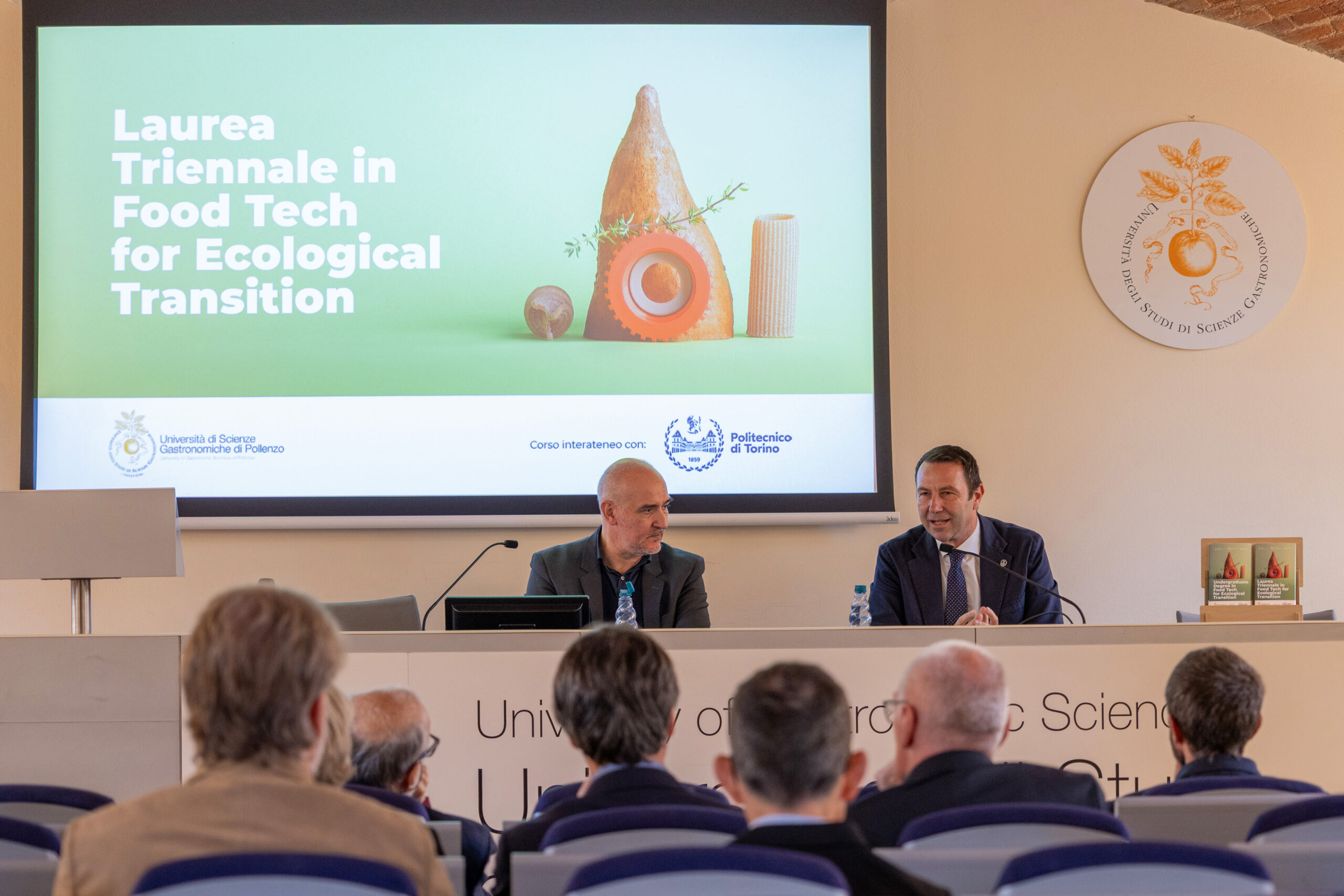
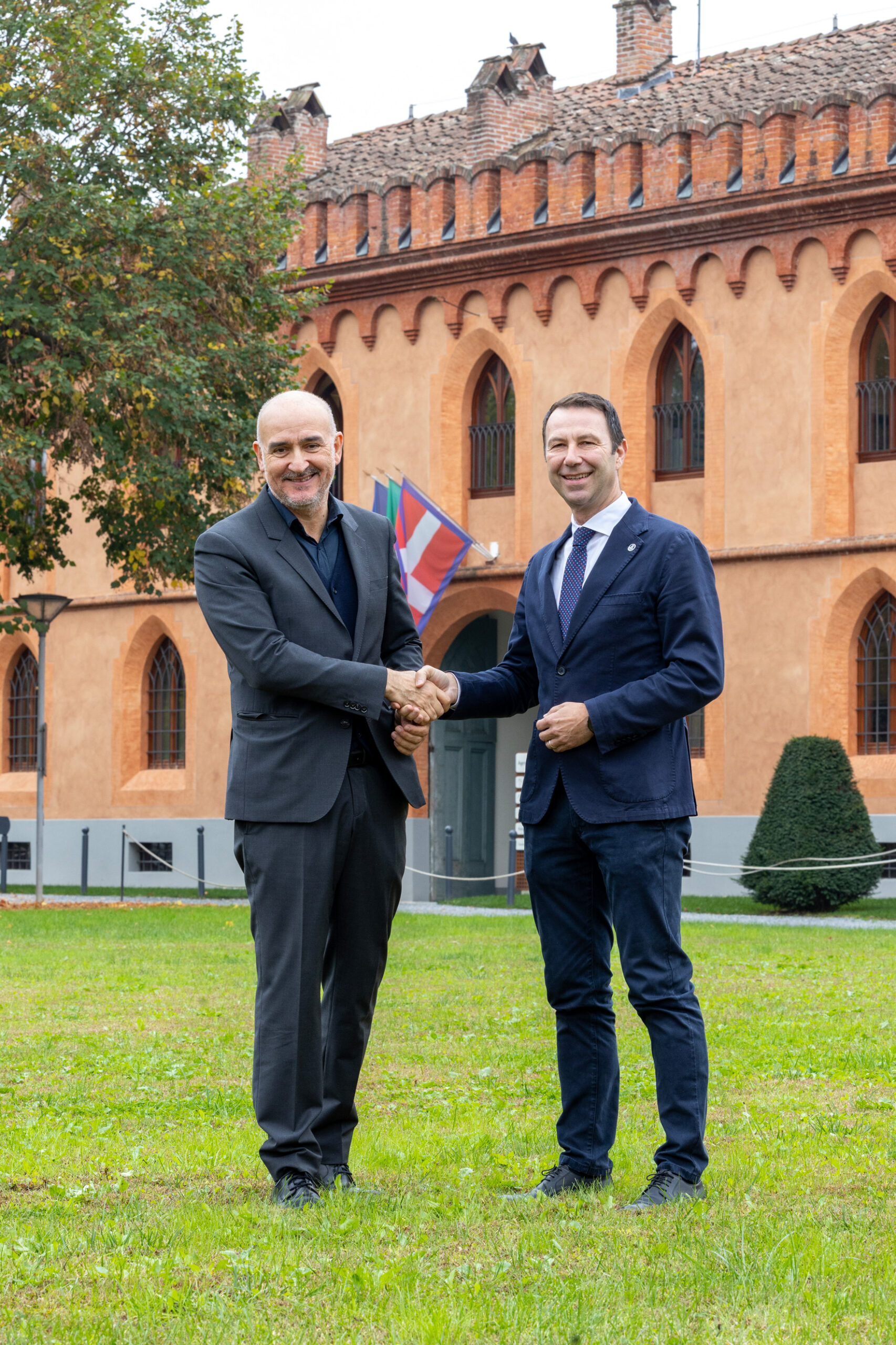
Rector Nicola Perullo of the University of Gastronomic Sciences of Pollenzo stated:
“The University of Pollenzo is at a historic turning point, as this is the first time we are launching an international three-year joint degree with such a prestigious institution as the Politecnico di Torino. The themes of this new and globally unique degree, which combines the scientific and technological expertise of the Politecnico with the strategic, ecological, and cultural competences of Pollenzo, are of fundamental importance for sustainable food development aligned with technological and social innovation. I am confident that this new programme will attract great interest from students all over the world, who will benefit from a multi-campus education in both Turin and Pollenzo, and from the highly transversal and original skills this programme offers.”
Rector Stefano Corgnati of the Politecnico di Torino added:
“With this collaboration, we are launching a strategic pathway that brings together our technological expertise with that of the University of Gastronomic Sciences in the sustainability of the food chain. We have created an innovative educational path focused on food quality, food chain safety, and sustainability in agricultural techniques, through a broad synergy between the complementary skills represented by our universities. This is a modern educational offering projected into an international context: students of this programme will become reference figures in both industrial and cooperative sectors, with specific sensitivity toward environmental sustainability and the rational use of water and energy in food-related processes. It is increasingly essential to train professionals capable of interdisciplinary interpretation across different fields of application.”
Programme specifics
The programme spans three years, with a maximum of 110 students admitted per academic year, and will take place across the two university campuses in Pollenzo and Turin.
First year: building a solid technical and scientific foundation with courses in Applied Mathematics, Computer Science, Economics of Sustainable Development, Ecology, Mechanics of Food Systems, Food Chemistry, and modules on Technology and Society. The curriculum also includes English Proficiency for Academic Research and Corporate Communication.
Second year: focus on food technologies with laboratories in processing, sensory analysis, circular economy, and systemic design. Courses introduced include Applied Physics and Electronics, Psychology of Eating Behaviours, Smart Packaging, and elective courses in advanced areas such as robotics, artificial intelligence, and geospatial tools.
Third year: courses in Food Law, Taste Technology, Management of Water and Energy Resources, and Carbon and Water Footprint of Food Products, concluding with an internship, thesis, and new fieldwork experiences.
A learning-by-doing approach
Each module includes practical activities in laboratories and in the field. Students do not merely acquire theoretical knowledge but learn to transform it into concrete solutions for food production, processing, and distribution. Field studies are an integral part of the programme, offering direct engagement with industrial, agricultural, and community realities.
Skills and opportunities
Graduates will become Research and Development Specialists focused on ecological transition:
- able to transform raw materials into finished products while reducing energy and water consumption;
- capable of converting production lines and turning by-products into new resources;
- knowledgeable in smart packaging techniques and sustainable logistics;
- proficient in using advanced data analysis tools, AI, automation, and sensor technologies;
- skilled in integrating technological innovation, food regulations, and governance.
With these competencies, graduates will find opportunities in processing industries, logistics companies, consultancy firms, public institutions, NGOs, or by launching start-ups aligned with ecological transition goals.
All information about the new Bachelor’s programme is available at:
https://www.unisg.it/corsi-iscrizioni/laurea-triennale-food-tech-for-ecological-transition/
UNISG Press Office
Tel. +39 0172 458574 / +39 329 9079183 – comunicazione@unisg.it
POLITO Web and Press Office
Tel. +39 011 0906319 / 3329 – relazioni.media@polito.it
