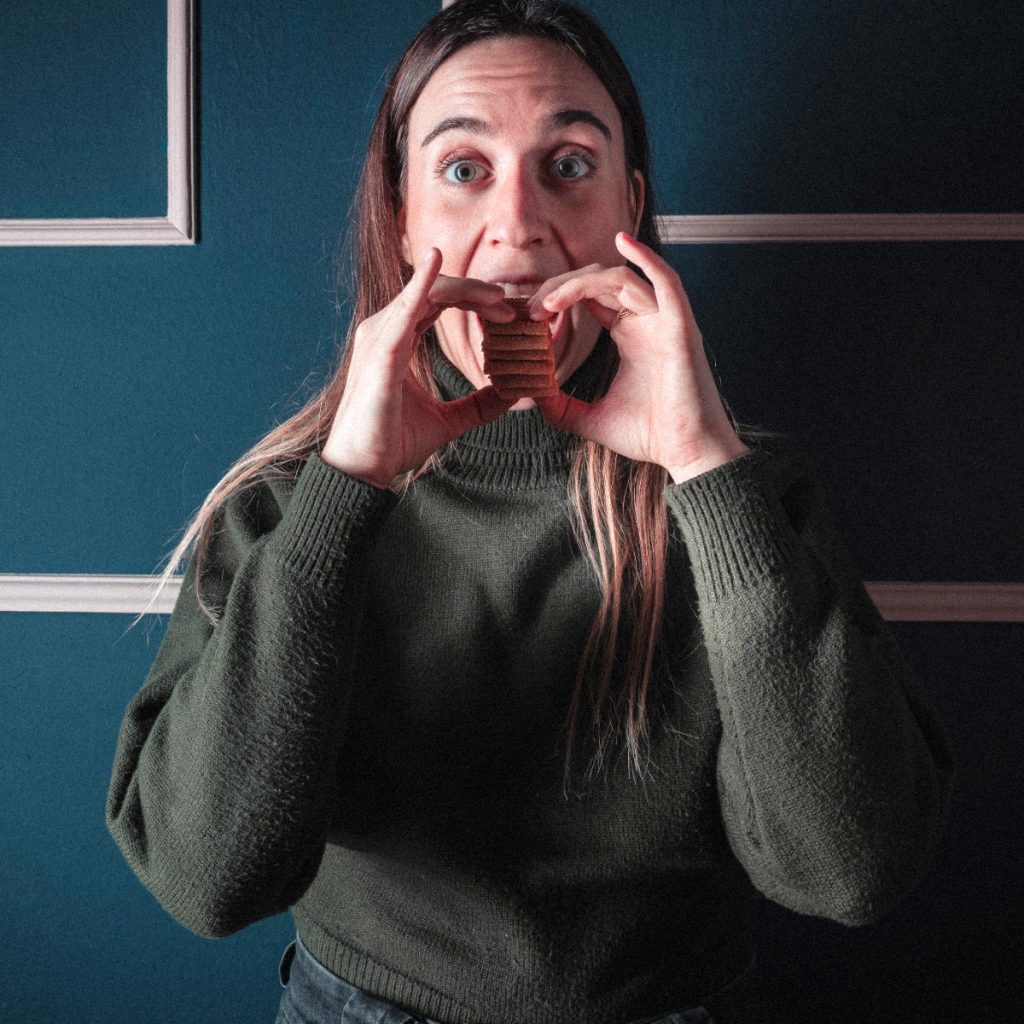
Silvia Paoli, UNISG Alumna and Mamù founder
Where does your passion for gastronomy come from and what brought you enroll at the Undergraduate Degree in Gastronomic Sciences and Cultures?
I have always been very attached to my land, Piedmont, which is truly a great and prosperous land from a gastronomic point of view. I've always dreamed of doing something deeply tied to my roots, which would allow me to elevate Piedmont and make it known. Gastronomy was the way that suited me the most. I was born and raised in a family in which gastronomy has always played an important role: my father's family, Piedmontese from Monferrato, has always had businesses related to agriculture, wine, and cooking, including the historic Bar Diana in Alessandria, serving dozens of agnolotti. Dad's stories speak of a childhood spent hiding in the bar door where the wheel of Parmesan was kept and picking peppers under the rasp directly from the bucket. (My grandparents thought that a mouse was wandering around the kitchen)
On the one hand, my mother's family comes from Molise, but they moved to the city and then to Monferrato. For them, the kitchen has always been a mean of communication: eating and finishing everything means "I love you." I have memories of making gnocchi with my grandmother, kneeling on a chair in front of the kitchen table and covered by an enormous pastry board. We used to go to the garden in the afternoon to pick fresh fruit and vegetables, which we would accompany with a basket full of sandwiches and basic necessities, some early cherries from Rivarone (the village where my grandmother lives), and a thousand shirts stained for life in an attempt to collect and devour them at the same time. I remember eating peaches and apricots straight from the tree and the lunches and dinners with agnolotti. The whole house was filled with the fragrances of the stew cooking for their filling.
Memories with my mom are especially sweet. My sister and I grew up cooking with her every day in the afternoon. We were fortunate to never eat anything processed; for snacks, we enjoyed fresh cakes, tarts, focaccias, homemade pizzas, cream puffs, or biscuits. Our friends were envious and loved joining us for a snack!
Choosing Pollenzo was a natural and love-at-first-sight decision for me.
How was your journey after graduation and what UNISG values accompanied you?
After graduating, I decided to explore the practical side of gastronomy by working in kitchens. It was a beautiful and sometimes challenging experience, but I learned valuable life lessons that made it easier for me to approach future jobs.
Throughout my journey, I have always carried with me the holistic approach instilled in me by UNISG. This includes a desire to thoroughly understand things from every angle and a passion and faith in an ideal I have made my own. The friendships I made at UNISG are also something I hold dear to my heart.
After completing my studies, I developed a genuine gastronomic approach to life. Culture, memories, and the history of a place, thing, or person all stem from the world of gastronomy.
Mamù, how did this family reality in Alessandria come about?
Mamù was born from a perhaps utopian idea: to do something for our city and Monferrato through gastronomy. It wasn't until Mamù was born that I realized I wanted to come home. The idea of showcasing a territory through its products, of telling its story through farmers, producers, and those who choose to travel a certain path every day, and bringing all of this to Alessandria - a city that was once considered grey and lacking in offeringsm - led us to make this choice. It's a real challenge; there are a thousand other places where everything would have been easier, but they would have had less meaning for us. We wanted to help this city take off and make our small contribution to make it known and discovered.
What do you recommend to young people who want to open new realities to preserve local traditions?
It will be very tiring. But that's exactly why it will be beautiful. Today doing something traditional is, in my opinion, the real innovation. We always try to do something innovative, unique, and outside the box. So many times, however, we forget the things that are before our eyes every day, which, perhaps for this reason, we take for granted. Tradition is the real revolution; bringing back ancient knowledge and doing it well with competence, awareness, and lovingness can change things.